
 France
 United Kingdom

When choosing a lightweight lead apron, many clinicians and buyers are shown a single number: “this apron weighs 5 kilograms”. But comparing lead apron weight across different brands is not that simple.
Two aprons can have the same listed weight and still feel very different to wear. That’s because apron weight is influenced by many different variables, such as type of apron, inner protection materials, lead equivalences, sizes, additional lengths for extra coverage, and even how the apron is tested.
This article helps healthcare professionals understand what really influences the weight of a lead apron. It highlights the important questions to ask radiation PPE suppliers to uncover the true weight of an X-ray apron, making it easier to confidently compare products across different brands.

Why Apron Weight Matters
Heavy aprons can cause fatigue, shoulder strain, and musculoskeletal discomfort (1 include resources), especially if you’re wearing them for long procedures. So weighing up comfort and protection is important for your long-term health and performance.
What Actually Affects Lead Apron Weight?
Apron Manufacturers often promote a single weight figure for lead aprons in marketing materials, but rarely explain what actually influences that number. Without this context, a quoted weight (such as 5 kg for a medium size) can be misleading, particularly as there are no universal sizing standards. A medium in one brand may have the dimensions of a large in another, making direct weight comparisons between brands unreliable.
The 4 Key Factors That Influence Lead Apron Weight:
- Apron Type
- Inner Protection Materials
- Lead Equivalences
- Sizes, Apron Cut (and Lengths)
1. Apron Type
Different lead apron styles influence weight:
- Front-only Aprons: cover just the front and is therefore lighter
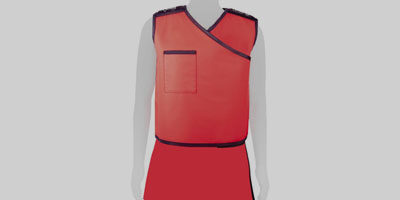
- Wraparound / one-piece apron: covers front and back, usually the entire weight of the apron is felt on the shoulders.
- Vest & Skirt Set/ Two-piece aprons: covers front and back, but splits weight between vest (40%) and skirt (60%) for better comfort

2. Inner Protection Materials
This is the core material of an apron, that actually stops x-rays and protects your body against x-ray and scatter radiation. There are three types of core materials on the market.
| Protection Material | Lead | Lead Composite | Lead-Free |
| Made of | Pure Lead | Pure Lead combined with composite material (e.g. aluminium, antimony, barium, bismuth, tin, titanium, or tungsten) | Combination of composite materials (e.g. aluminium, antimony, barium, bismuth, tin, titanium, or tungsten) |
| Weight Indication | Heaviest | Slightly lighter (5-8%) than pure lead | Lightest (can be up to 30% lighter than pure lead) |
| Level of Protection | Highest protection 50/60 kVp to 150 kVp | Optimum protection 50/60 kVp to 110/ 120 kVP | Optimum protection 50/60 kVp to 110/ 120 kVP |
| Length of Procedures | Short | Short to Medium | Medium to Long |
| Application Areas | Veterinary, Dentistry, Day Surgeries, Nuclear Medicine | Veterinary, Dentistry, Surgeries | All interventional procedures, surgeries |
3. Lead Equivalence
Lead equivalence (often written as 0.25mm Pb, 0.35mm Pb, 0.50mm Pb) tells you how much radiation the apron can stop. It is essentially the protection thickness of the inner protection material of a lead apron. Higher lead equivalence generally means:
- Increased apron weight
- more radiation protection
- more shielding material (thicker)
Lead Equivalence also varies by apron style. A front-only apron provides front protection and is labelled either 0.25mm Pb, 0.35mm Pb or 0.50mm Pb, while a vest and skirt (two-pieces) set is labelled either 0.35/0.25mm Pb or 0.50/0.25mm Pb, reflecting front and back protection. The added rear shielding increases total weight and must be considered when comparing aprons.
The minimum required lead equivalence is usually stated in international (IEC 61331-1.2014 and IEC 61331-3.2014) and respective domestic Radiation Protection Standards.
4. Size of Lead Aprons

Comparing lead apron weights between different manufacturers based on size alone is unreliable, as there are no universal sizing standards. A “medium” apron in one brand may have the dimensions of a “large” in another. That makes direct weight comparisons tricky unless you look closely.
For accurate comparisons, it is always recommended to review each manufacturer’s sizing charts rather than relying on size labels alone.
Apron length can also varies by manufacturer and region significantly. Because length is highly dependent on the wearer’s height, standard options may not always provide adequate coverage. The IEC radiation protection standard requires protection from the thyroid to just below the knee, so aprons sit above the knee would not be compliant.
The Only Accurate Way to Compare Apron Weights: Ask for the Area Density
Instead of asking “How many kilograms does it weigh?”, the most accurate comparison is to look at Area Density. This measures the weight of protective material (lead or lead-free) in g or kg per square metre achieve a specific lead equivalence (e.g. 0.25mm Pb) at a specific energy range (50 to 150 kVp), so you’re comparing apples to apples.
This allows you to:
- Compare different brands fairly
- Remove size and cut from the equation
- Identify genuinely which protection material is the lightest

This lets you tell which aprons are genuinely lighter, without the confusion caused by different sizes or testing methods.
With quite a few lead apron manufacturers on the market, how can you find out who has the lightest weight aprons?
Practical Examples: Choosing the Lightest Lead-Free Apron
For Front-only protection
Imagine you are looking to purchase the lightest front lead apron (according to IEC standards) and you are comparing three different apron brands/ manufacturers to find out who is the lightest lead-free supplier. All three offer:
- Lead-free protection
- 0.25 Pb lead equivalence
- Comparable apron type: front apron

At this point, comparing total apron weight in kilograms won’t help because each brand may use different sizing and/ or standard lengths.
You need to ask all brands or manufacturers “What is your area density for 0.25mm Pb lead-free material?”
| Brand A | Brand B | Brand C | |
| Protection Material | Lead-Free | Lead-Free | Lead-Free |
| Lead Equivalence | 0.25 | 0.25 | 0.25 |
| Diagnostic Range | 60-110 kVp | 60-110 kVp | 60-110 kVp |
| Type of Apron | Front protection | Front protection | Front protection |
| Area Density for 0.25mm Pb | 3.12 kg/m2 | 2.93 kg/m2 | 3.45 kg/m2 |
| Light | Lightest | Heaviest | |
| Evaluation Result | Brand A is lighter than brand C but heavier than brand B. | Brand B offers the lightest weight lead-free material for their aprons. | Brand C is the heaviest option out of brand A and B. |
For Front and back protection
Now you are choosing to buy the lightest front and back lead apron combination (according to IEC standards) and you are comparing three different apron brands/ manufacturers. All three offer:
- Lead-free protection
- 0.50/0.25mm Pb lead equivalence
- Comparable apron type: Vest & Skirt, Wraparound aprons

Again, comparing total apron weight in kilograms won’t help because each brand may use different sizing and/ or standard lengths.
You need to ask all brands “What is your area density for 0.50mm Pb and 0.25mm Pb lead-free material?”
| Brand A | Brand B | Brand C | |
| Protection Material | Lead-Free | Lead-Free | Lead-Free |
| Lead Equivalence | 0.50/0.25mm Pb | 0.50/0.25mm Pb | 0.50/0.25mm Pb |
| Diagnostic Range | 60-110 kVp | 60-110 kVp | 60-110 kVp |
| Type of Apron | Front & back protection | Front & back protection | Front & back protection |
| Area Density for 0.50mm Pb | 6.00 kg/m2 | 5.56 kg/m2 | 6.45 kg/m2 |
| Area Density for 0.25mm Pb | 3.12 kg/m2 | 2.93 kg/m2 | 3.45 kg/m2 |
| Light | Lightest | Heaviest | |
| Evaluation | Brand A is lighter than brand C but heavier than brand B. | Brand B offers the lightest weight lead-free material for their aprons. | Brand C is the heaviest option out of brand A and B. |
Key Summary
In simple terms, in order to get a true picture of a lead apron’s weight, healthcare professionals should always ask for the Area Density of the protection materials in a specific lead equivalence. This is the only way to compare “apples with apples” as factors such as diagnostic imaging range, lead equivalences, size and type of lead garment vary between manufacturers.
Area density removes confusion caused by
- Different sizing systems
- Varying “standard” apron lengths
- Marketing-driven weight claims
By comparing the same lead equivalence, using the same protection material, you can confidently identify the lightest and most efficient radiation protection, without relaying on misleading weight numbers.
Before you buy a personal xray gown always ask your Medical Physicist, Radiation Safety Officer or Chief Radiographer what the radiation protection guidelines are within your medical department to understand what the minimum protection requirements for a lead apron are.

